

Each month, Rachel Lambert – foraging guide, artisan maker and award-winning author – will be writing a journal for us, reflecting on the changing seasons and observations on nature and landscape around us. Rosyansow is the Cornish word for wanderings or ramblings, and for the months of November and December, she has written about the mighty oak.
Creativity, Ink and Imagining the Forest

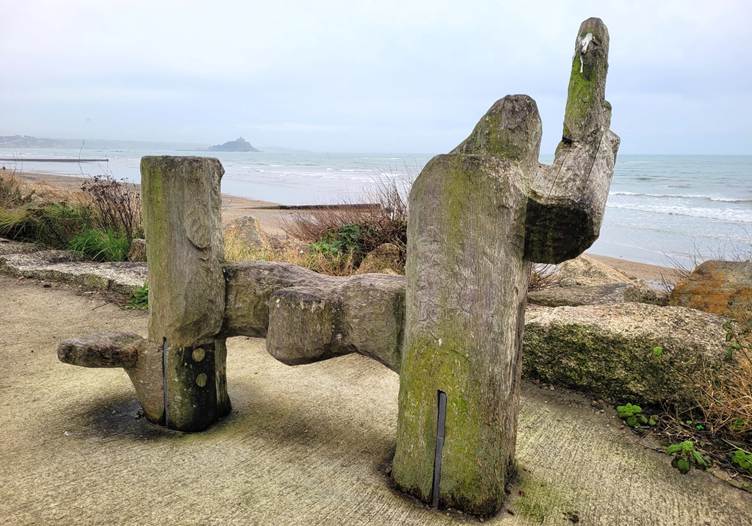
Abstract and minimal in shape, Emma Smith’s oak sculptures are dotted along the coast path between Penzance and Marazion – there are 85 of them, to be exact. Did you know that Emma chiselled each of them by hand? Their shapes were informed by local people’s body measurements in their favourite resting poses.


Emma chose oak for its weather hardiness, but also because it would have been one of the trees in the ‘submerged forest’ between here and the Isles of Scilly. Named Gwelen, I was lucky enough to participate in Emma’s project and learnt how her work was inspired by this forest.
It is thought to have started to disappear under rising seawaters about 6,000 – 10,000 years ago, which is about the same time our human imagination started to develop. Emma told me how her sculptures, or ‘seeing sticks’ were an ode to our ability to imagine the forest which is no longer there.
Have you ever sat on, leaned on or stood next to one of the Gwelen sculptures and tried to imagine the sea being a forest?
Closer to home, Grace Stephenson, the Business Development Apprentice here at The Gardener’s House has been collecting and creating with oak galls. Grace’s sell-out workshop at the Gardener’s House took participants through the process of extracting and using the ink from the galls.
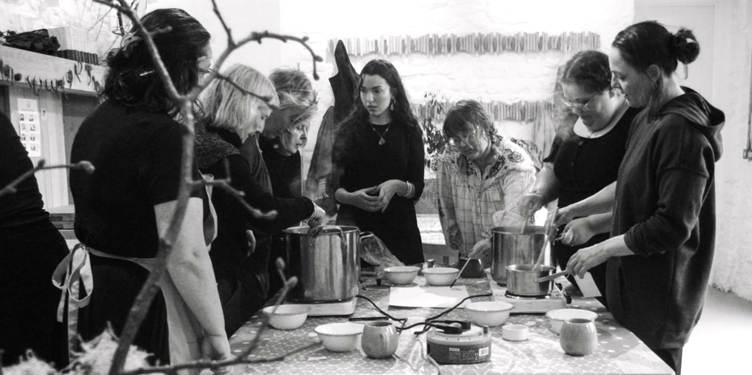

During our conversation, Grace told me there are 70 different types of oak gall wasp in the UK, and that in the 1840s, a wasp from the Middle East was imported so the UK could produce their own galls, as opposed to importing them for ink making.
Did you know that texts written by Shakespeare and drawings by Leonardo da Vinci were all done with ink from oak galls and the colour can last hundreds of years?
Looking into The Gardener’s House archive, our two native species here are; Pedunculate oak (Quercus robur) and the Sessile oak (Quercus petraea). The Cornish Biodiversity Network which supports wildlife recording confirms that despite the Pedunculate oak being a common tree in Cornwall, it is rare in exposed areas like West Penwith.
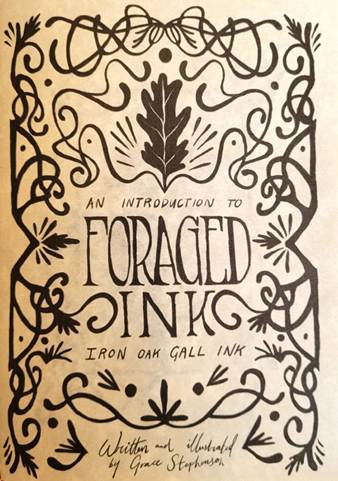
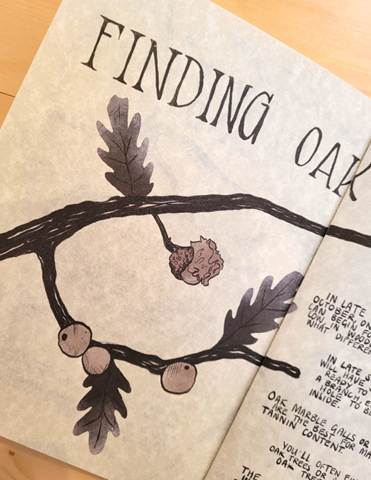
If you’d like to find out more about the process of making ink from oak galls, Grace has made a beautiful and informative zine describing the process. It is on sale, along with her handmade oak gall ink, at The Gardener’s House shop. Why don’t you try to draw oak trees with the handmade ink, or use your imagination and put ink to paper to depict the submerged forest in Mounts Bay?
You might also want to visit Newlyn Art Gallery to see local artist Kate Walter’s drawings made with oak gall ink.
KATE WALTERS at NEWLYN ART GALLERY runs 25 November 2025 to 24 January 2026. Kate Walters’ latest series of drawings began in the wilds of the Abruzzo National Park in Italy, where she undertook an artist residency in August 2024. Inspired by the landscape’s ancient beauty and raw vitality, she worked directly with natural materials gathered from the forest floor.
Using fallen oak galls crushed between rocks to make ink, and porcupine quills found along woodland paths as pens, Walters created a body of work deeply rooted in place. The resulting drawings explore themes of wildness, occupation, and resolution, reflecting the forest’s layered histories, from its natural rhythms to traces of human conflict.
