
Each month, Rachel Lambert – foraging guide, artisan maker and award-winning author – will be writing a journal for us, reflecting on the changing seasons and observations on nature and landscape around us. Rosyansow is the Cornish word for wanderings or ramblings, and for the month of January, she has written about tamarisk for us.

The feathery leaves of Tamarisk or Salt Cedar (genus Tamarix) are dotted along our coastline and tell a story of resilience and travel. Although that story is not embedded into the Gardeners’ House archive, until now…

(Image credit: wal_172619 – Pixabay)
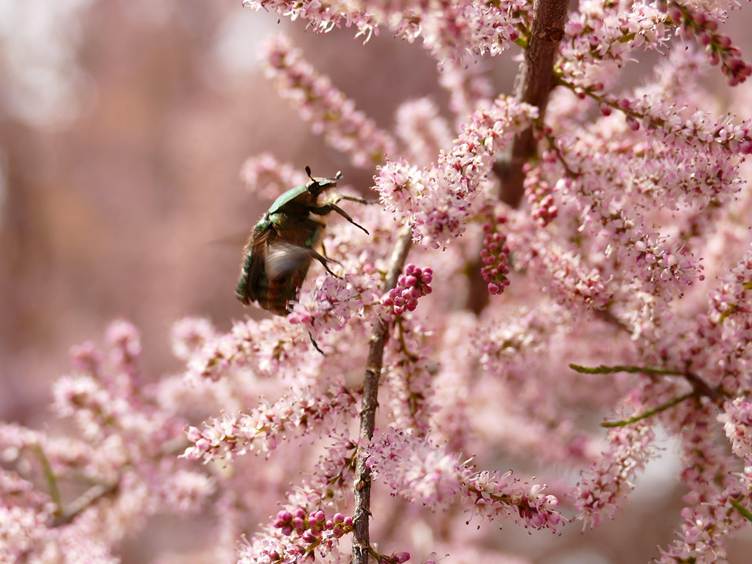
Well-loved by coastal walkers, especially when its pretty pink flowers appear, which could be anytime from spring to autumn, that’s April right through to September. This makes them a great early source of nectar for pollinating insects too.
(Image courtesy of: ykaiavu – Pixabay)
Tolerant of drought, salinity and salt spray, not only is Tamarisk perfect for our shores, but its suitability to our home surely means that it will travel with us as the climate continues to shift.
I look to Tamarisk as a plant that embraces change; exposure to the elements, changing weather patterns and to new vistas that are far from its original home in drier areas of Eurasia and Africa. According to the Country Gardener, one head gardener has been lobbying for its acceptance as a logo for the county of Cornwall, such is their love of Tamarisk. Surely, we have much to learn from this thriving coastal dweller.

Its thought that Tamarisk would have originally been brought to our shores for its beauty and perhaps also its function as a shelter belt. Talking to Tim Westwell of Trenow Fields, he tells me how they have planted Tamarisk to extend their current shelterbelt on their farm. Situated above Trenow cove and between Marazion and Perranuthnoe, this makes perfect sense. Tim went on to say that, as part of Forest for Cornwall they have started to propagate Tamarisk in the hope to share this wonderful plant with others in the future.

Actually, Tamarisk is a tree or deciduous shrub rather than a plant, it can grow up to 18 metres high and is classified as an evergreen. However, this winter I’ve been enjoying its autumnal colours, especially in the absence of dense forest here in West Cornwall.
Records show that Tamarisk has been on the British Isles since the 1500s, where it was cultivated in gardens. At least in Cornwall, it has now spread up and down the coast, as shown from this map from Flora of Cornwall (courtesy of: Cornwall Biodiversity Network).

At some point in history, those long, spindly branches were also used in basket making. Back in the autumn, lobster pot maker, Barry Mundy from Mullion Cove shone light on this fact in his talk at The Museum of Cornish Life. Winter is actually the perfect time to harvest for pot making, which would have been a winter activity in Cornish fishing villages up and down the county.

Have you spotted Tamarisk along the coast?
Did you know it’s history as a wind break and material for pot making?
What other plants and trees are resilient to climate change?